

Barre chords (often written as bar chords) are very versatile guitar chords, which are movable to any fret on the fretboard in a given shape. Barre (bar) actually refers to the positioning of the index finger of your fretting hand, which must be laid across and holding down several strings at once.
Your index finger will take the role of the nut, allowing you to take open chords and play them anywhere on the neck with the rest of your fretting fingers.
BARRE CHORD VIDEO TUTORIAL
I recommend you watch this video guitar lesson on bar chords and how to hold barre chords, it’ll show you up close and teach you the real power of the barre chord.
Barre Chord Shapes
As I mentioned, the power of bar chords is that you can take your basic open chords, and play them anywhere on the fretboard. Because of this, a bar chord is said to have a specific shape.
There are 5 main bar chord shapes you should know (which is actually called the CAGED system). You’ll see that once you learn how to hold each shape, you can take almost any chord you learned as a beginner, and play it anywhere on the neck. As a result, you'll instantly know almost a hundred new chords.
Let's have a look at all of the standard major-minor barre shapes, first of all, starting with the easiest shapes, and getting progressively more difficult.
E Shape Barre Chords
Why is it an E shape?
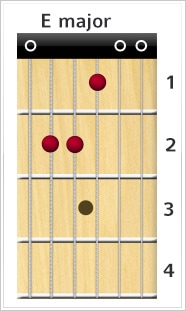
Because it derives from the E major chord you are already familiar with. The chord chart you see here is of a normal E major.
As you know, you strum every string when you play this chord, which will mean that you’ll have 3 open strings ringing. Your root note is E.
Now if you place your index finger firmly against every string at fret 3 for example, and line up your other fingers to an E major shape, all you did was move the E major up 3 frets. Your index finger substitutes the nut, so those otherwise open strings will be held down by your index finger, the bar:
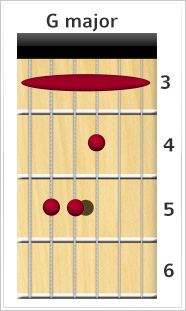
This will mean that you are now playing a G major, since your root note, being held down by your index finger, is G (fret 3 of the low E string).
And as with the original E minor you have probably learned already, you can take the E minor shape, and apply it to your bar chord, by lifting your second finger off the fretboard, so that string is held by your bar as well.
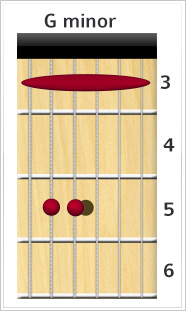
This results in a G minor, since you're holding the E minor shape, rooting at the G note (fret 3 of the low E string).
So as you see, you took the basic chord shapes of E major and E minor, and apply them at a different point of the fretboard.
Holding a correct bar is pretty difficult for beginners, not to mention getting used to the fingering. Watch this video to get some tips on how to hold a bar chord, and also make sure you start learning guitar songs with barre chords.
At first, you will probably not be able to hold down the bar correctly, and mute the strings, or make them buzz. This is totally normal, it will get better as your fingers strengthen. It will take time, since holding a bar chord is not exactly the easiest thing in the world.
Some tips on holding down a bar chord:
- You have to place your barre finger as close to the metal fret as possible, without being on the fret itself.
- Your barre finger should be rolled onto its side slightly, not laying flat, this way your finger bone is more in contact with the strings, not the fleshy part of your finger.
- The tip of your bar finger should extend over the top edge of the fretboard.
- Pivot your wrist all around to find the most comfortable position. Moving your wrist forward, away from you tends to help, since it straightens your bar finger and makes it flatter across the strings.
- Pinch the back of the guitar neck very hard with your thumb, this will make your barre finger firm across the strings.
- The non-barre fingers are curled, so that only the fingertips are fretting the strings.
- Practice it until all strings ring out clearly.
- You’ll need to really strengthen your hand and fingers to hold down bar chords correctly, so make it a regular part of your daily practice session. At first, it’ll be very hard, but it gets easier day by day as your fingers get stronger.
A Shape Barre Chords
As with the E major you just learned, you can move the A major shape around the fretboard as well.
This is the regular A major with the root on the A string, note that the low E string is not used in this chord:
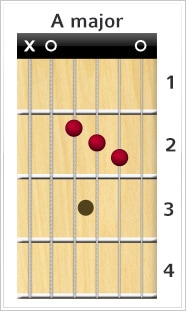
Now just like with the E shape barre chord, you will need to form a bar over the strings with your index finger.
Since the low E string is not used, you only need to hold down all the strings from string A. Now you can take this basic chord shape, and move it anywhere on the fretboard. The tone of the new chord will be whatever note you are at on the A string, since that is your root.
For A shaped major chords, you’ll be laying 2 bars, the first with your index finger, and the second with your ring finger. Watch the high E string, your ring finger should not be holding it down. Most guitarists can’t get the high E string to ring at your index finger bar, since our fingers are just too big, so we just mute the high E string by slightly touching it with our ring finger.
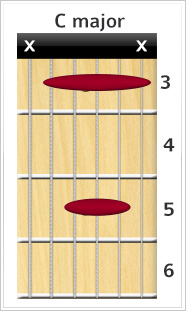
So our new chord is a C major barre chord, since we are rooting it on the 3rd fret of the A string, which is a C note.
And as you might have guessed, you can hold down the A minor shape as well.
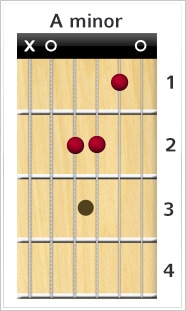
Just hold the bar with your index finger, and move it wherever you like. Notice that your second, third and fourth fretting fingers are holding down the shape of the E major shape bar chord, which make changing from the E major shape to this A minor shape all the easier, since you just move your fingers down each by 1 string.
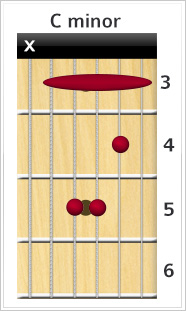
This is now a C minor barre chord.
C Shape Barre Chords
The C-shaped bar chord is based on the C major chord you already know. The root note is the note C on string B fret 1, held by your first finger. The low E string is not used on the C major.
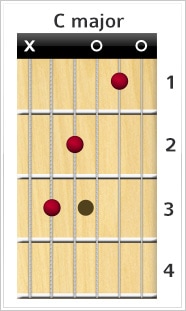
As with the E shape and the A shape, you can shift this chord anywhere on the fretboard as well. Try moving it up by 3 frets, and placing a barre across the strings at fret 3.
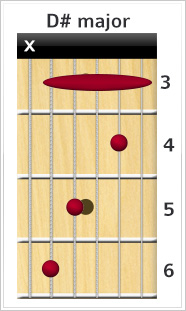
You now have a D# major, since the root note is fret 4 on the B string.
Now this bar chord is tricky, there's no doubt about it. Your fretting fingers have to stretch to far off frets, while your barre finger has to hold down 5 strings as well.
Again, all I can say is be patient, it takes practice, but it’ll be more than worth it. Do not create shortcuts and just bar the higher 3 strings. You will later be doing pull-offs with your pinky, and be catching them with your barre finger, so get used to holding all the strings required for this bar chord.
Now the C shape barre is not for beginners, it's just too difficult. Don't fuss too much about it, just get a hang of the E and A shapes first, and leave the C shape for later, when your hands are a bit stronger.
G Shape Barre Chord
The basic G major chord you’ve already learned can also be made into a barre chord and taken all over the fretboard. As you’ll remember, this was your G major chord, with the root on fret 3 on the low E string (a G note):
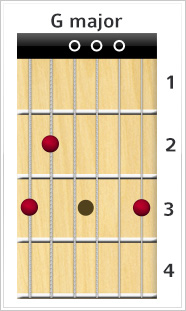
Now just like with the previous barre chords, turn your index finger into the nut by forming a bar over all of the strings this time, and position your other fretting fingers as you would to hold down a G major shape.
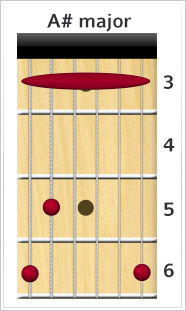
The above chord becomes an A# major, since your root is at fret 6 of the low E string.
Now if you thought the C shape barre was hard, try the G shape! This is a very tricky bar chord, so don’t forget, practice makes the master! Keep at it, practice it every day, and you’ll have it sounding great soon.
Barre your index finger across all the strings firmly, fret the other notes, and try to get all of the strings to ring clearly. Do this several times, then stop and practice something else, and come back to the G major shaped bar chord the next day. You’ll see, that it will get easier day by day, there is no need to rush anything.
D Shape Barre Chord
Yep, you guessed it, the D shape bar chord originated from the D major chord you already know. The root here is the open D string, so the D note.
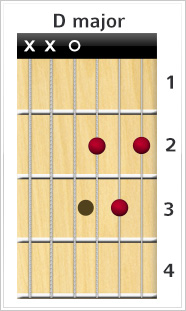
And turning the D shape into a bar chord, you can take it anywhere on the fretboard.
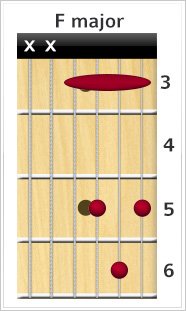
The above chord is an F major, since the root is at the 3rd fret of the D string, which is an F note.
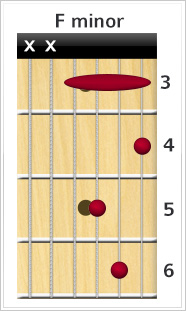
You can also form the D minor as a bar chord, which derives from the basic D minor chord as well:



The C shaped Barre is the A STRING ROOT. YES IT CAN BE THE B STRING but I thought by definition all roots were first note played on LOWEST string.