

First of all, a shocker: power chords are not real chords!
A power chord is, in fact, a diad, which is 2 notes played together. Guitar power chords are very versatile since the shape can be moved all over the fretboard, as with bar chords.
Power chords are mostly played on electric guitars under distortion. Mostly rock and heavy metal guitar players use power chords, since it gives a low, aggressive sound under distortion, and give a feeling of raw power.
Palm-muting is often applied to power chord riffs, to get a cool muffled thump sound.
Beginner Tip
If you are just starting out, and you want to learn chords, check out this video guitar lesson on guitar chords.
How to Play Power Chords
As mentioned above, guitar power chords are diads, comprised of the root note and the 5th degree on the major scale.
As such, power chords are neither major nor minor, since the third degree of a normal chord would specify whether it’s a major or minor chord. This is because they don't have a third degree, and the third degree tells you whether a chord is major or minor. These 2 notes are played together, and since you only play these 2 notes, you can move them around the neck of the guitar.
There are 3 main reasons rock guitarists love to use power chords:
- They allow for fast chord changes, since the power chord shape is the same everywhere on the fretboard.
- They sound aggressive under heavy distortion, which is a must in heavy metal.
- They are neither major nor minor, so you can change key constantly.
Power chords on the low E string
A typical guitar power chord shape is the following, note the 1st degree (the root note) and the 5th degree, as specified by the major scale.
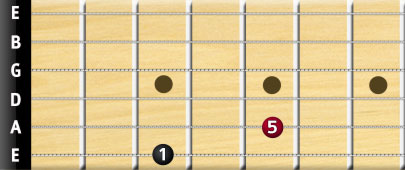
The above is the typical power chord shape rooting on the E string. The power chord above happens to be a G power chord, since the root note is on the 3rd fret of the low E string, which is a G note.
This power chord shape can be played anywhere along the fretboard, keeping the root on the E string. Most guitar players typically use the first and third fretting fingers to hold the power chord shape.
Since you pluck power chords very fast, it is advisable to hold down the D string as well, since if you hit it by accident, the open D string would sound dissonant.
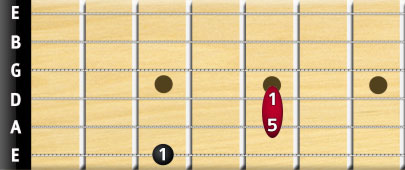
Note that even though we're holding down 3 strings, we still only have 2 notes in our G power chord, since the new note on the 5th fret of the D string is a G, just like on the low E string. In fact, the new note is exactly 1 octave above the root G.
Power chords on the A string
This shape can also be used on power chord rooting on the A string, and again, the shape can be played with any root on the A string.
The below is a C power chord since it roots on the C note.

Again, I would advise you to hold down the D string with your ring finger.

Power Chord Songs
Learning songs that use power chords is the best way to get better at using them. It's loads of fun too. Check out these guitar lessons on songs that use power chords.
Extended Root Power Chords
You can extend the root of power chords played on the A string, by holding down the low E string at the fret where you are rooting the power chord on the A string. This is because if you look at the major scale, that E string note will be a 5th-degree note as well. You can achieve deeper, fuller sounding A root power chords with this method.

Open Power Chords
An open power chord is one where the root note is the open string, and the 5th degree is the second fret on string A (if the root is the low E string), or string D (if the root is the open A string).
Basically, these are the traditional E and A open chords, the only difference being is that you only play the lowest 2-3 strings of the chord.
Drop D Tuning and Powerchords
Many metal guitarists use drop D tuning instead of standard tuning.
Why?
With drop D tuning, you lower the pitch of the low E string to D, which is 2 semitones, or 1 whole note down.
The result is that all you have to do to play a power chord is bar strings E and A at the same fret. You can then take this shape and move it all over the fretboard on these strings, making it very versatile and easy to hold down.
Sticking with the example of the G power chord, it is now rooting on the 5th fret, since because of the drop D tuning, we tuned our low E string down 2 semitones to D.
